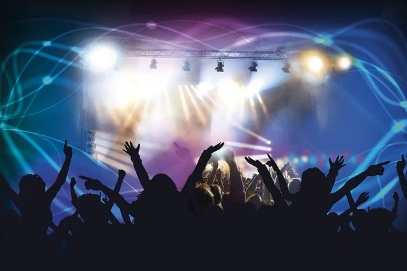
Walking into a concert or music festival, those laser beams that cut through the night and dance to the rhythm can always ignite the atmosphere in an instant. But many people don’t know that stage laser lights are essentially different from the common LED lights and moving head lights we see, and the core differences lie in three key characteristics.
First is “coherence”. The photons of ordinary lights are disorganized and will gradually diverge during propagation, while the photons of laser lights are neat and synchronized, able to maintain a straight beam. Even when projected dozens of meters away, the outline remains clear and sharp. Second is “monochromaticity”. Laser has a single and pure wavelength. The color saturation of red light (635nm–660nm), green light (520nm–532nm), and blue light (445nm–465nm) is extremely high, which is more visually impactful than ordinary colored light. Among them, 520nm green light is the first choice for high-end performances because it is the most sensitive to the human eye. Finally, “directionality”. Laser hardly diverges, and in a smoke or haze environment, it can form iconic aerial light bands, which is also the key for laser lights to create special effects such as “laser galaxy” and “light rain”.
Simply put, ordinary lights “illuminate the space”, while stage laser lights “outline light and shadow”, using precise beams to turn the rhythm and emotion of music into a visible visual feast.