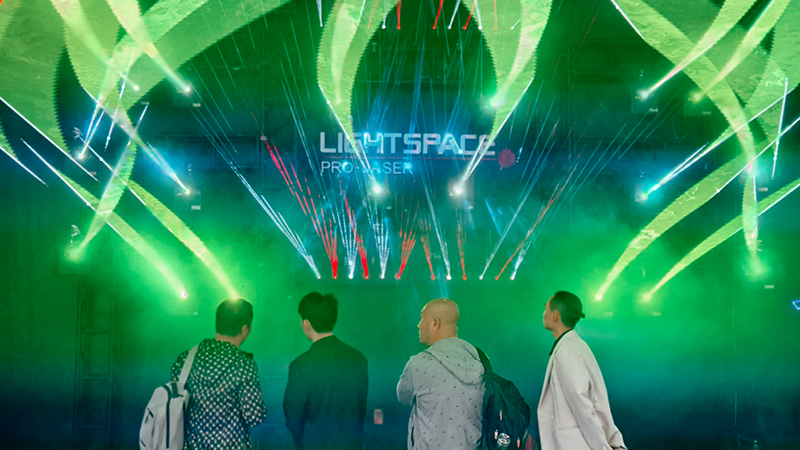
When buying stage laser lights or talking about special effects at performances, you are always confused by parameters such as “power”, “scanning speed” and “wavelength”? In fact, you don’t need to remember too many. Grasp 3 core parameters, and you can quickly judge the quality of the equipment and the suitable scenario.
The first key parameter: Output Power (Unit: mW/W). Pay attention to distinguishing between “nominal power” and “actual output power”. The power promoted by some products is inconsistent with the real output. When purchasing, you can ask the supplier for test instructions. Low power (≤500mW) is suitable for small scenarios, high power (>2W) requires professional operation, and medium and low power is suitable for home use or small commercial performances.
The second key parameter: Scanning Speed (Unit: °/s). Scanning speed determines the smoothness of the dynamic effect of the beam. Low speed (below 3000°/s) is suitable for static pattern display, medium speed (5000-8000°/s) is suitable for soothing melodies, and high speed (above 10000°/s) is suitable for fast-paced electronic music and rock performances, which can create a very tense light and shadow rhythm.
The third key parameter: Wavelength (Unit: nm). Wavelength determines the laser color. 650nm pure red light is suitable for warm atmosphere, 532nm emerald green light is suitable for fresh scenes, and 445nm blue light creates a mysterious sense of technology. For full-color laser lights, attention should be paid to color gamut coverage. Professional equipment should have a color gamut of more than 85% of the Rec.2020 standard to avoid color aliasing and distortion.
In addition, the protection level (IP65 or above for outdoor use) and control protocol (DMX512/ILDA compatible) also need to be paid attention to according to the scenario to avoid mismatch between parameters and needs.