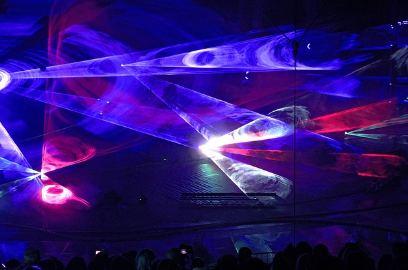
Although the stage laser light looks small, it can produce shocking light and shadow effects. Behind it is the coordinated work of 5 core components, among which the laser diode is the “heart”.
Core Component 1: Laser Diode. This is the core of generating laser. Diodes with different wavelengths correspond to laser lights of different colors. Its quality directly determines the brightness, stability and service life of the beam. High-quality diodes can avoid beam attenuation and color distortion during use.
Core Component 2: Galvanometer Scanner (Galvos). It is equivalent to the “eyes” of the laser light. It controls the direction of the laser beam by rotating the lens at high speed. The faster the scanning speed, the smoother the dynamic effect of the beam. The scanning speed of high-end equipment can reach more than 10000°/s.
Core Component 3: Optical System (Mirror + Lens). It is responsible for shaping and guiding the beam, making the beam more concentrated and the outline clearer, while filtering stray light to avoid blurred light spots and beam divergence. Regular cleaning of optical lenses is also the key to maintaining the laser light.
Core Component 4: Control System. It is divided into built-in programs and external consoles. High-end equipment supports AI-assisted pattern generation and wireless remote control, which can realize the projection of complex patterns and text, and even link with other lights and audio to create an immersive effect.
Core Component 5: Cooling System. High-power laser lights generate a lot of heat during operation. The cooling fan or fanless heat dissipation structure can prevent the equipment from overheating and avoid damage to the laser diode, which is also an important factor affecting the durability of the equipment.